Destiny Matrix vs Human Design: A Lifestyle Approach to Two Self‑Discovery Systems
Have you ever explored Human Design or the Destiny Matrix and felt inspired, but still found yourself confused about why certain patterns keep repeating in your life or how to actually apply these insights in your daily routine? Both of these popular self discovery systems come from different traditions, yet they share a common goal: helping you understand your personality, life direction, and deeper purpose. Human Design focuses on your energy flow and decision making style, while the Destiny Matrix uses numerology to map your life potential, cycles, and key turning points. Many people compare or confuse the two, but in reality, they are not competitors instead, they are complementary systems that offer a more complete understanding of your career, relationships, and personal growth.
In this article, we will explore the major differences, similarities, and real-life examples of both systems so you can clearly understand how these systems explain your life in different yet connected ways. This comparison will help you see which system resonates with you more and how both can be used together for deeper self-awareness and personal development.
Jump to any section to explore Destiny Matrix vs Human Design. Click the Table of Content 👇
Meet the Destiny Matrix: your life’s blueprint
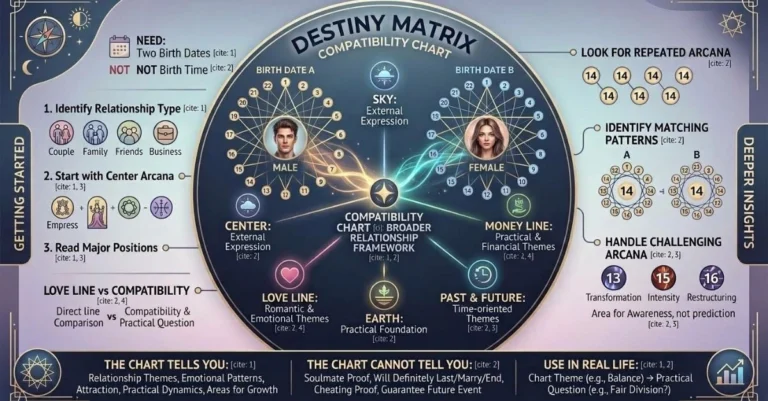
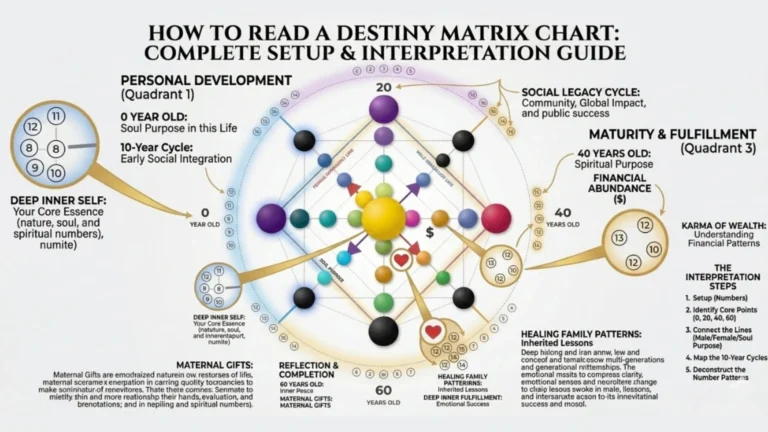
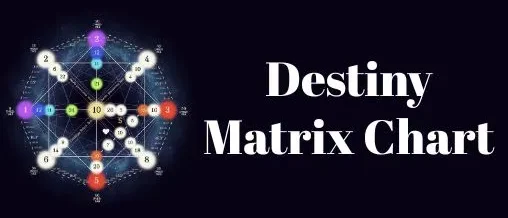
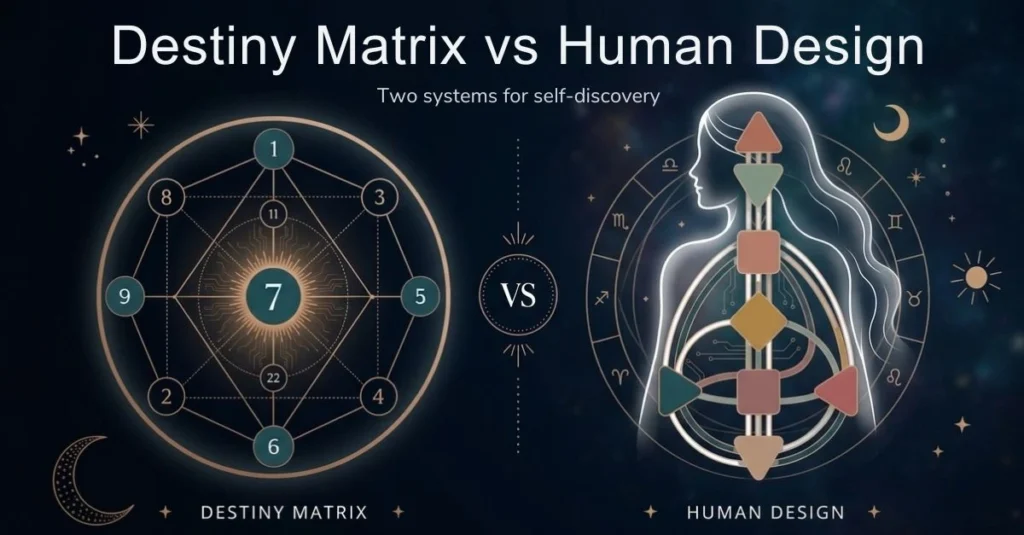
The Matrix of Destiny is a numerology-based system that converts your birth date into core and secondary numbers. These numbers form a grid of 22 archetypal energies, called Arcana, which are connected to different areas of your life. It helps you understand your personality, life direction, and hidden patterns.
Here are some important features:
Portrait Zone
This represents your first impression — how other people see you at first glance. It is based on your birth day number (or its sum if it is higher than 22). For example, Arcana 3 can show a creative and stylish personality, while Arcana 1 can give a strong leadership presence.
Money Line
The Money Line shows how you deal with money and resources. In a positive state, it brings ease and flow, while in a negative state, it can show fear, stress, or financial imbalance.
Karmic Tail
The Karmic Tail represents old patterns and inherited lessons stored in your subconscious mind. It works like a hidden program in the background of your life. Once you understand it, you can choose to continue or change these patterns.
Central Arcana (Inner Self)
This is your core inner energy that shows who you truly are. It is calculated from your birth date and often creates a strong sense of self-recognition. You can think of it as the “heartbeat” of your chart.
Meet Human Design: Your Personal User Manual
Human Design is a self-discovery system that combines astrology, the I Ching, the chakra system, and Kabbalah. To create your BodyGraph, you need your exact birth date, time, and location, as even a small change can affect your design.
Main Elements of Human Design
Type
Your Type (Manifestor, Generator, Manifesting Generator, Projector, Reflector) explains how your energy naturally functions and how you interact with the world around you.
Strategy and Authority
These are your decision-making tools and personal guidance system. For example, Generators are designed to respond to opportunities, while Projectors often achieve the best results when they receive recognition or invitations.
Centers, Channels, and Gates
These elements reveal which energies are consistent and reliable within you (defined) and which areas are more influenced by your environment and experiences (undefined). (e.g., 3/5, 4/6) Your Profile describes the role you naturally play in life and highlights the personality traits, behaviors, and experiences that shape your journey.
Meet Human Design: Your Personal User Manual
Human Design is a self-discovery system that combines astrology, the I Ching, the chakra system, and Kabbalah. To create your BodyGraph, you need your exact birth date, time, and location, as even a small change can affect your design.
These are the key areas where both systems help you understand and improve different parts of your life.
In relationships, both systems provide useful guidance. Destiny Matrix highlights partnership patterns and emotional tendencies, while Human Design helps you understand communication styles and emotional needs. These insights help you better understand your relationship behavior and improve habits that may create misunderstandings or conflicts. .
Career planning benefits from insights provided by both systems. Destiny Matrix helps you understand your natural talents, life purpose, and financial potential, while Human Design shows how you make decisions and which work style helps you perform best. When both systems are used together, it becomes easier to understand which opportunities are most suitable for you and in which direction your growth potential is strongest.
For personal development, Destiny Matrix identifies repeating life lessons and hidden challenges that may slow down your progress. Human Design explains where you are most influenced by the outside world and how to align with your authentic energy. Applying both systems in practical life can significantly improve self-awareness, confidence, and overall personal growth.
Real-Life Case Studies
Here are some real examples showing how these systems work together in practical life situations.
Case 1 — Ethan
Ethan’s Destiny Matrix showed strong 3 and 8 energies, which represent creativity, expression, and ambition. In Human Design, he was a Generator with Sacral Authority. He learned that instead of chasing every opportunity, he should only follow what naturally creates a response in his energy.
Case 2 — Olivia
Olivia’s matrix had a strong 6 core energy, representing responsibility, care, and completion. In Human Design, she was a Manifestor. She realized her role was to initiate new ideas and create meaningful change for others.
Case 3 — Noah
Noah’s Destiny Matrix showed a missing number 2, which relates to partnership and emotional balance. In Human Design, he was a Reflector. He learned that he gains more clarity and makes better decisions when he is in a stable and supportive environment.
Case 4 — Sophia
Sophia’s core 11 energy represented intuition and inner guidance. This aligned with Human Design Gate 57 (Intuitive Clarity). This combination gave her a strong ability to sense right timing in business and life decisions.
Case 5 — Liam
Liam had a dominant 9 energy in his matrix, representing spirituality and insight. In Human Design, he was a Manifesting Generator. He learned that combining thinking and action helped him grow his skills and career much faster.
Case 6 — Ava
Ava’s matrix showed a missing 5 energy, which represents freedom, flexibility, and adaptability. In Human Design, she had an undefined Solar Plexus Center. After understanding this, she focused more on emotional awareness and better collaboration, which improved her relationships and teamwork.
Key Practical Differences (Simple Version)
Here are the main practical differences between the two systems in a simple and easy-to-understand way.
Shadow Work and Focus
Matrix of Destiny
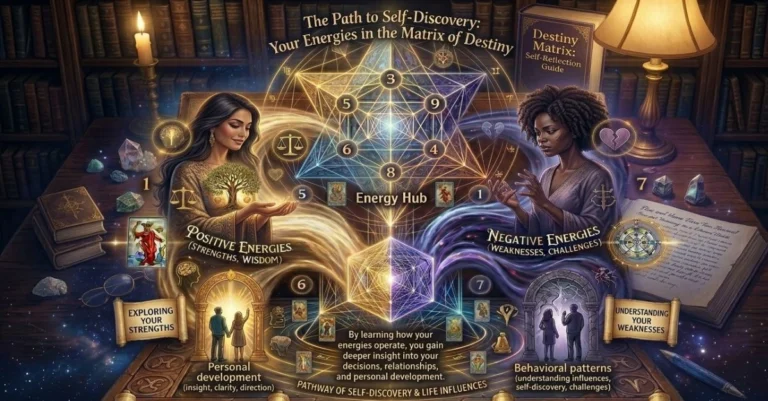
This system mainly focuses on shadow work. It shows which of your energies are in positive (plus) or negative (minus) states. The main purpose is to help you understand hidden patterns and improve them in your life.
Human Design
This system focuses more on how you are naturally designed to live. It gives you Strategy and Authority to help you make better decisions and avoid outside conditioning. Shadow work is not its main focus.
Way of Working
Human Design
It gives clear guidelines on how to act in life, such as when to respond, when to wait, and when to initiate — based on your Type.
Matrix of Destiny
It is more interpretation-based. It explains your energy patterns but does not give strict rules on what exactly you should do.
Level of Complexity
Human Design
It is a more detailed and complex system, including Types, Profiles, Gates, Channels, and many layers.
Matrix of Destiny
It is a simpler system with limited positions that use 22 Arcana energies to describe your life patterns.
Real-World Use Cases
Here is a simple comparison of how both systems work in real-life situations.
| Area | Destiny Matrix | Human Design |
|---|---|---|
| Career | Identifies talent and life purpose | Shows best work style and decision-making method |
| Relationships | Emotional patterns and compatibility | Communication style and energy dynamics |
| Personal Growth | Shadow patterns and life lessons | Conditioning and self-awareness |
| Daily Life | Helps understand life themes | Guides real-time decision making |
Foundational Differences
Here is a simple breakdown of the foundational differences between the two systems.
Data Inputs
Matrix of Destiny:
This system only uses your date of birth. It does not require your birth time or location for calculation.
Human Design:
This system uses your date of birth, exact birth time, and birth location. Even a small change in time can change your chart.
Data Inputs
Matrix of Destiny:
This system is based on numerology. It uses numbers from your birth date to generate meaning. It includes 22 Arcana energies that represent different human behaviors and life patterns.
Human Design:
This system is a combination of four systems:
- I Ching (ancient symbols)
- Kabbalah system
- Chakra system
- Astrology
It was developed by Ra Uru Hu in 1987 after a spiritual experience.
Origin
Matrix of Destiny:
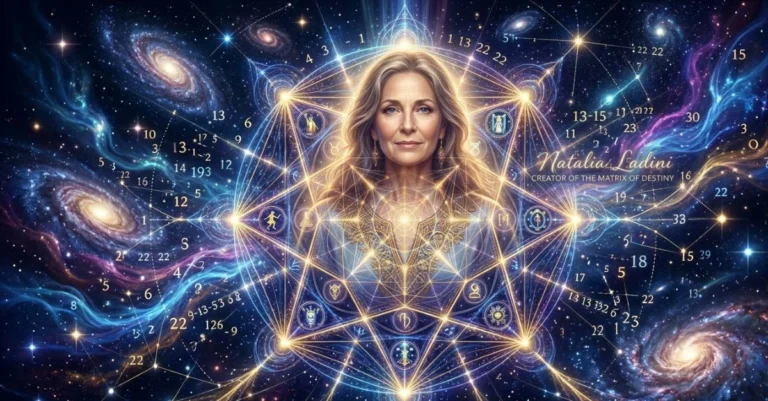
It was introduced by Natalia Ladini in Russia in 2006, based on earlier numerology work by Herbert Reichstein.
Human Design:
It was created by Ra Uru Hu (Alan Robert Krakower) in 1987 after a mystical experience in Ibiza, which he described as a transmission from a non-physical intelligence.
Quick Comparison Table
This table gives a quick side-by-side comparison of both systems to help you understand their key differences in a simple way.
| Feature | Destiny Matrix | Human Design |
|---|---|---|
| Base System | Numerology + Tarot Arcana | Astrology + I Ching + Chakra system |
| Input | Just birth date | Birth time + date + location |
| Focus | Life patterns & karma | Energy flow & decision making |
| Complexity | Easy | Advanced |
| Main Use | Self-understanding | Life strategy & guidance |
Which System Should You Choose?
Choosing between Destiny Matrix and Human Design depends on what you want to understand about yourself.
If you are a beginner and want simple clarity about your life themes, strengths, and hidden patterns, then Destiny Matrix is a good starting point. It is easier to understand and gives quick insights about your personality and life direction.
If you want deeper understanding about how you make decisions, how your energy works, and how you interact with the world, then Human Design is more suitable. It is more detailed and practical for daily life guidance.
Is everything comparable? Not always—and that’s okay
Sometimes you will notice that a few points in both systems match well, but many do not. This is because Destiny Matrix and Human Design are based on different philosophies.
Destiny Matrix mainly uses numerology and Tarot concepts, while Human Design is a mix of astrology, I Ching, and other systems. So instead of forcing a perfect comparison, it is better to understand them as two different perspectives — like two friends who explain life in different ways. Where there is similarity (like identity or inner self), you can combine both. And where there is difference (like karmic tail and will center), simply understand that each system speaks its own language.
Frequently Asked Questions (FAQs)
Final Thought: Two Maps, One Journey
In the end, both Destiny Matrix and Human Design help you live a more aware and conscious life. Destiny Matrix gives you a “map” that shows the themes, patterns, and karmic lessons in your life. Human Design gives you a “guide” that shows how you can use your energy, decisions, and behaviour in a better way.