Destiny Matrix Career: What Your Chart Reveals About Your Career
Choosing a career is rarely as simple as finding one job title that matches your personality. You may have several interests, different skills, or a career that looks good on paper but does not suit the way you prefer to work.
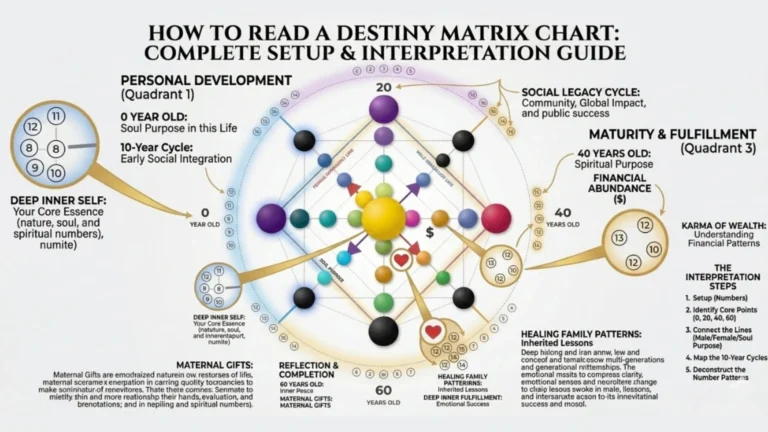
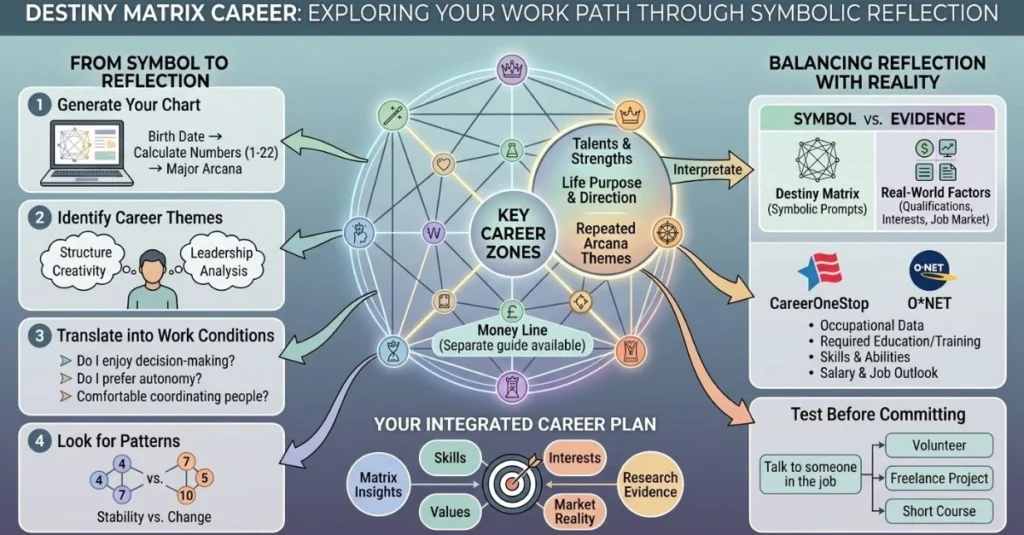
A Destiny Matrix career reading can be used as a symbolic way to explore those questions. The system uses a birth date to calculate numbers from 1 to 22 and connects them with the Major Arcana. Each number is interpreted according to its position in the chart. Within the system, the number provides a symbolic theme, while the position provides context.
The important distinction is that a chart can provide reflection prompts, but it cannot establish that you are destined for a particular profession. It does not measure your qualifications, local job opportunities, salary prospects, or actual performance.
A useful career reading therefore combines symbolic interpretation with information about your interests, skills, work preferences, education requirements, and real-world experience.
Jump to any section to explore What Your Chart Reveals About Your Career . Click the Table of Content 👇
What Is Destiny Matrix Career?
Destiny Matrix career interpretation is the use of a Destiny Matrix birth-date chart to explore possible work-related strengths, preferences, environments, and directions.
The system commonly uses 22 Arcana as a symbolic vocabulary. Several values are calculated from the birth date and placed in different parts of the chart. This means there is not necessarily one universal career number that can name your ideal profession.
A career-focused reading can instead explore questions such as:
- What kinds of activities might I enjoy exploring?
- What strengths or behaviors appear repeatedly in my chart?
- Do I prefer structure, independence, creativity, analysis, leadership, service, or variety?
- What type of work environment might suit those preferences?
- Which careers are worth researching further?
- Does my real experience support the interpretation?
These questions make the chart more useful than simply matching one number to one occupation.
Which Parts of the Destiny Matrix Can Be Used for Career?
Destiny Matrix methods can use different chart positions and terminology, so one layout should not automatically be treated as universal. Current Matrix of Destiny material explains that the same Arcana can carry a different emphasis depending on its position in the chart.
For career reflection, the most useful areas are generally those associated with talents, strengths, direction, purpose, and repeated Arcana themes.
Talent and Strength Themes
Talent-related positions can be interpreted within the system as themes connected with how a person may prefer to learn, contribute, communicate, organize, create, or solve problems.
For example, a symbolic theme associated with structure could lead you to explore whether you enjoy:
- organizing systems
- setting clear standards
- managing responsibilities
- improving processes
- coordinating people or resources
That does not prove that management or operations is the right career for you. It gives you a specific idea to compare with your actual interests and abilities.
Life Purpose and Direction
Purpose-related parts of the chart are often interpreted as broader themes of direction and meaning.
For career reflection, you can translate that interpretation into practical questions:
- What type of contribution feels meaningful to me?
- Do I want my work to involve people, ideas, systems, creativity, service, or leadership?
- What type of problem would I be willing to work on for years?
- Does my current work connect with the values that matter to me?
A symbolic purpose theme should not be treated as a fixed obligation or proof that one profession is your true calling.
Repeated Arcana
A number that appears in several positions can be interesting to examine because the same symbolic theme may appear in different contexts.
However, repetition does not prove that a person has a stronger measurable ability. It is more useful as a prompt:
Where does this theme actually appear in my behavior, interests, education, or work experience?
This keeps the interpretation connected to observable evidence.
Money Line
The Money Line is often included in career-related Destiny Matrix discussions, but it is a separate topic from a complete career assessment.
Since you already have a dedicated resource for that subject, it does not need to be explained in detail here. Readers who want to explore it separately can visit the Destiny Matrix Money Line guide.
How to Read Your Destiny Matrix for Career
A useful career reading does not stop after identifying an Arcana. Work through the chart in several steps.
1. Generate Your Destiny Matrix Chart
Start with your birth date and use a calculator that clearly explains its calculation method.
Write down the career-relevant positions rather than trying to interpret every number in the chart at once.
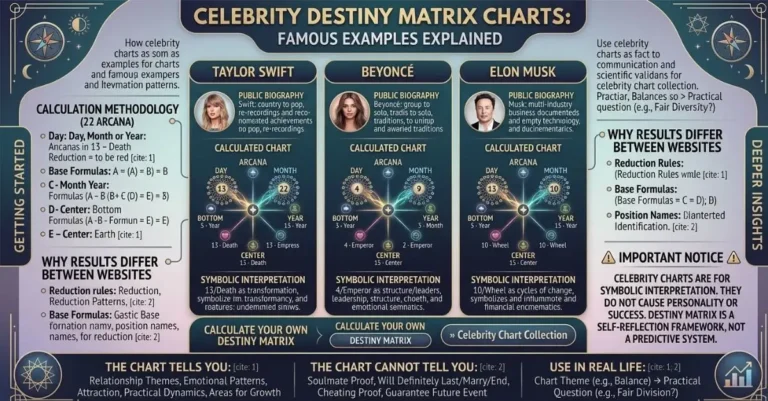
If you compare results from different Destiny Matrix websites, check whether they use the same calculation rules. Different systems can use different layouts, labels, or interpretations.
2. Identify Your Career-Related Themes
Look at your talent or strength-related positions and your purpose-related themes.
Instead of immediately asking:
What job does this number mean?
ask:
What kind of behavior or working condition could this theme represent?
For example, a symbolic theme associated with structure could become:
- organizing information
- creating repeatable processes
- managing responsibility
- setting boundaries
- maintaining standards
Those are behaviors that can actually be observed and tested.
3. Look for Patterns
Look for themes that appear more than once.
You can also look for combinations that seem to pull in different directions.
For example, your chart might symbolically suggest both:
- structure and stability
- experimentation and freedom
Instead of choosing one and ignoring the other, consider careers where both can exist.
A project-based role, for example, may provide clear goals while still allowing room to experiment.
4. Translate Symbols Into Work Conditions
Career decisions become more useful when symbolic language is converted into everyday work conditions.
Instead of saying:
“This Arcana means you should become a leader.”
ask:
- Do I enjoy taking responsibility?
- Do I like making decisions?
- Do I prefer autonomy?
- Am I comfortable coordinating other people?
- Do I enjoy creating systems?
- Would I rather lead projects or work independently?
This creates a much more specific career question.
5. Compare the Interpretation With Real Evidence
Your chart is only one source of reflection.
Compare it with:
- skills you can actually demonstrate
- tasks you enjoy
- tasks that consistently drain you
- feedback from teachers, managers, clients, or colleagues
- your preferred work environment
- education and training requirements
- financial responsibilities
- available jobs in your location
Current O*NET information organizes occupations around career interests, abilities, work styles, skills, knowledge, education, experience, training, licensing, work activities, work context, and labor-market information.
Destiny Matrix Career Meanings: The 22 Arcana
The 22 Arcana can be used as a symbolic vocabulary for career reflection. The themes below are not scientific measurements of career ability and should not be interpreted as guaranteed occupations.
The same Arcana can also have a different emphasis depending on its chart position.
| Arcana | Symbolic career theme | Work conditions to explore | Example career areas |
| 1, The Magician | Initiative, focused action, using available resources | Autonomy, creation, problem-solving | Entrepreneurship, sales, product work, creative projects |
| 2, The High Priestess | Observation, intuition, quiet analysis | Research, reflection, information gathering | Research, analysis, writing, specialist work |
| 3, The Empress | Creativity, development, cultivation | Creative and productive environments | Design, content, education, creative business |
| 4, The Emperor | Structure, authority, organization | Clear responsibility, systems, leadership | Management, operations, administration |
| 5, The Hierophant | Teaching, knowledge, guidance | Structured learning and knowledge-sharing | Education, training, consulting |
| 6, The Lovers | Choice, relationships, alignment | Collaboration and communication | Counseling, partnerships, client work |
| 7, The Chariot | Direction, determination, movement | Goal-oriented and active environments | Project leadership, logistics, sales |
| 8, Justice | Balance, judgment, standards, accountability | Rules, evidence, fairness, precision | Compliance, auditing, quality, analysis |
| 9, The Hermit | Depth, independence, reflection | Focused and relatively independent work | Research, writing, analysis, specialist roles |
| 10, Wheel of Fortune | Change, cycles, adaptability | Variable environments and changing priorities | Entrepreneurship, marketing, dynamic industries |
| 11, Strength | Courage, persistence, controlled energy | Resilience, responsibility, people interaction | Leadership, coaching, management |
| 12, The Hanged Man | Perspective, patience, alternative approaches | Reflection and flexible problem-solving | Research, creative work, strategy |
| 13, Death | Transformation, renewal, releasing outdated structures | Change and transition | Restructuring, transformation work, change management |
| 14, Temperance | Balance, integration, coordination | Collaboration and combining skills | Project coordination, operations, mediation |
| 15, The Devil | Desire, attachment, power, material motivation | High-stakes goals and awareness of incentives | Business, sales, negotiation, entrepreneurship |
| 16, The Tower | Disruption, truth, rebuilding | Problem-solving during major change | Crisis management, technology, restructuring |
| 17, The Star | Hope, visibility, inspiration | Creative or public-facing environments | Media, design, content, communication |
| 18, The Moon | Imagination, sensitivity, uncertainty | Creative, exploratory, interpretive work | Writing, arts, research |
| 19, The Sun | Visibility, clarity, achievement | Open communication and visible contribution | Leadership, education, media |
| 20, Judgement | Review, renewal, accountability | Evaluation, reflection, meaningful change | Coaching, assessment, leadership |
| 21, The World | Completion, integration, broader connection | Large-scale or cross-functional work | International business, global projects |
| 22, The Fool | Freedom, curiosity, experimentation, new beginnings | Flexibility and exploration | Entrepreneurship, creative projects, emerging fields |
These are symbolic career themes, not one-to-one job recommendations. Current Destiny Matrix material similarly presents the Arcana as symbolic themes and emphasizes reading the number together with its chart position rather than treating one number as a complete description or prediction.
How to Interpret Multiple Career Numbers Together
One Arcana rarely provides enough context to make a career decision.
A better approach is to compare themes across your chart.
Talent + Purpose
Ask:
What am I symbolically encouraged to develop, and what type of contribution seems meaningful?
For example, if your talent-related themes point toward communication while your purpose-related themes emphasize teaching or contribution, you might investigate careers where communication is used to help people learn.
That could include education, training, content, consulting, or other fields.
The chart does not determine which one is correct. Your skills, qualifications, interests, and experience still matter.
Repeated Themes
If several positions point toward structure, investigate how much structure you actually enjoy.
Potential questions include:
- Do I like predictable processes?
- Do I enjoy responsibility?
- Am I comfortable with rules and standards?
- Do I prefer managing systems or creating new ones?
If several themes point toward creativity, ask whether you prefer:
- visual creativity
- writing
- problem-solving
- product creation
- storytelling
- innovation
Turning a broad symbol into a specific behavior makes the interpretation easier to test.
Tensions Can Be Useful
A chart does not have to look perfectly consistent.
Suppose one theme suggests stability while another suggests freedom. That does not automatically mean your chart is contradictory.
It may point toward a career environment that provides:
- stable goals but flexible methods
- structured projects but independent execution
- predictable responsibilities but varied tasks
Career exploration becomes more useful when you search for these combinations instead of forcing every number into one profession.
What If Your Destiny Matrix Suggests Several Careers?
Having several possible career directions is normal.
Career research should not force you to choose the first occupation that appears to match a symbolic interpretation.
Create a short list and compare the options.
| Question | Career A | Career B | Career C |
| Do I genuinely enjoy the main tasks? | |||
| Do my current skills fit? | |||
| What skills do I still need? | |||
| How much education or training is required? | |||
| Does the work environment suit me? | |||
| Does the role fit my preferred level of independence? | |||
| What are the financial requirements? | |||
| What does the current job market look like? | |||
| Can I test the career before committing? |
This approach is consistent with established career-exploration resources. CareerOneStop recommends exploring interests, skills, work values, career information, and then narrowing career options.
Destiny Matrix Career vs. Career Assessments
A Destiny Matrix reading and an established career assessment serve different purposes.
| Destiny Matrix | Evidence-based career resources |
| Uses a birth-date calculation | Uses assessments, occupational data, or career research |
| Interprets symbolic Arcana | Examines interests, skills, abilities, work styles, values, and requirements |
| Useful for personal reflection | Useful for researching actual occupations |
| Can generate questions about preferred work | Can provide occupation-specific information |
| Does not establish qualifications | Can show education, training, experience, or licensing requirements |
| Does not predict salary | Can provide labor-market and salary information where available |
| Does not guarantee career success | Provides evidence that can support career planning |
How to Turn a Destiny Matrix Reading Into a Real Career Plan
The most useful part of a career reading is what you do after interpreting the chart.
Check Your Career Interests
Start with the activities you genuinely enjoy.
Career interests can include preferences for hands-on work, investigation, creative activities, helping people, business-oriented activity, or organized work. O*NET’s career interest framework uses six broad interest types to help people explore occupations.
Ask:
- What tasks make me curious?
- What subjects do I naturally research?
- Do I prefer people, ideas, data, tools, or creative work?
- Do I prefer working indoors, outdoors, remotely, or across different settings?
Check Your Actual Skills
Interest alone is not enough.
List skills you can demonstrate today, such as:
- writing
- communication
- analysis
- programming
- design
- sales
- organization
- teaching
- project management
- technical work
Then separate those from skills you would need to develop.
O*NET distinguishes skills and knowledge from broader worker characteristics and also includes education, experience, training, and licensing information.
Consider Your Work Values
Two people can have similar skills but want very different working lives.
You might value:
- independence
- achievement
- stability
- recognition
- relationships
- supportive management
- particular working conditions
A career that uses your skills but conflicts with your most important work values may still feel unsuitable.
Research the Actual Occupation
Once you have two or three realistic options, research what the jobs actually involve.
Look for:
- daily tasks
- required education
- training
- certifications or licenses
- experience requirements
- working conditions
- typical employers
- salary information
- employment outlook
- opportunities in your location
CareerOneStop’s career profiles are designed for this type of occupation research and cover more than 900 occupations.
Test Before Making a Major Change
You do not always need to leave your current career to find out whether another field suits you.
Depending on the occupation, you might:
- talk to someone already doing the job
- take a short introductory course
- complete a small project
- volunteer
- shadow someone
- freelance on a limited basis
- take on a related responsibility at work
- build a portfolio sample
A small experiment can give you information that a symbolic interpretation cannot.
Can Destiny Matrix Help With a Career Change?
It can be used as a reflection tool during a career change.
For example, you might use your chart to explore whether you want more:
- autonomy
- creativity
- structure
- collaboration
- responsibility
- variety
- learning
- public interaction
Then investigate whether those conditions actually exist in the careers you are considering.
Do not assume that a difficult current job means the entire profession is wrong.
Problems with a job can come from many sources, including workload, management, schedule, unclear expectations, compensation, or the specific work environment.
Identify the actual problem first.
If you dislike your manager but enjoy the work itself, changing employers may be a different solution from changing careers entirely.
Can Destiny Matrix Predict Your Career, Salary, or Success?
A Destiny Matrix chart should not be treated as a reliable method for predicting your specific profession, salary, hiring outcome, promotion, or long-term career success.
Within the Destiny Matrix framework, Arcana are symbolic interpretations. They can be used to generate ideas and questions, but they do not measure whether you have the qualifications required for a particular occupation.
They also cannot account for factors such as:
- your education
- professional experience
- local job availability
- licensing requirements
- financial responsibilities
- workplace conditions
- employer expectations
- actual performance
For decisions involving substantial financial, educational, or career consequences, use the chart alongside practical evidence rather than instead of it.
Destiny Matrix Career Checklist
Before choosing a career based on your chart, ask:
- What career themes appear in my chart?
- Which themes actually match my behavior?
- What work activities do I enjoy?
- Which skills can I already demonstrate?
- Which skills would I need to develop?
- What type of work environment suits me?
- What work values matter most to me?
- What education or training does the occupation require?
- What does the local job market look like?
- Can I test the career before making a major commitment?
- What evidence would make me reject the option, even if the chart seems to support it?
That last question is useful because it keeps the process grounded in evidence instead of looking only for information that confirms the reading.
Frequently Asked Questions (FAQs)
Final thoughts
A Destiny Matrix career reading is most useful when you treat it as a starting point for reflection rather than a final career verdict.Use the chart to identify symbolic themes. Turn those themes into questions about the kind of work you enjoy and the environment in which you want to work. Then check those ideas against your real skills, interests, values, qualifications, and the occupations available in your market.The chart can help you generate better questions. Your experience, research, qualifications, and circumstances should help you answer them.